
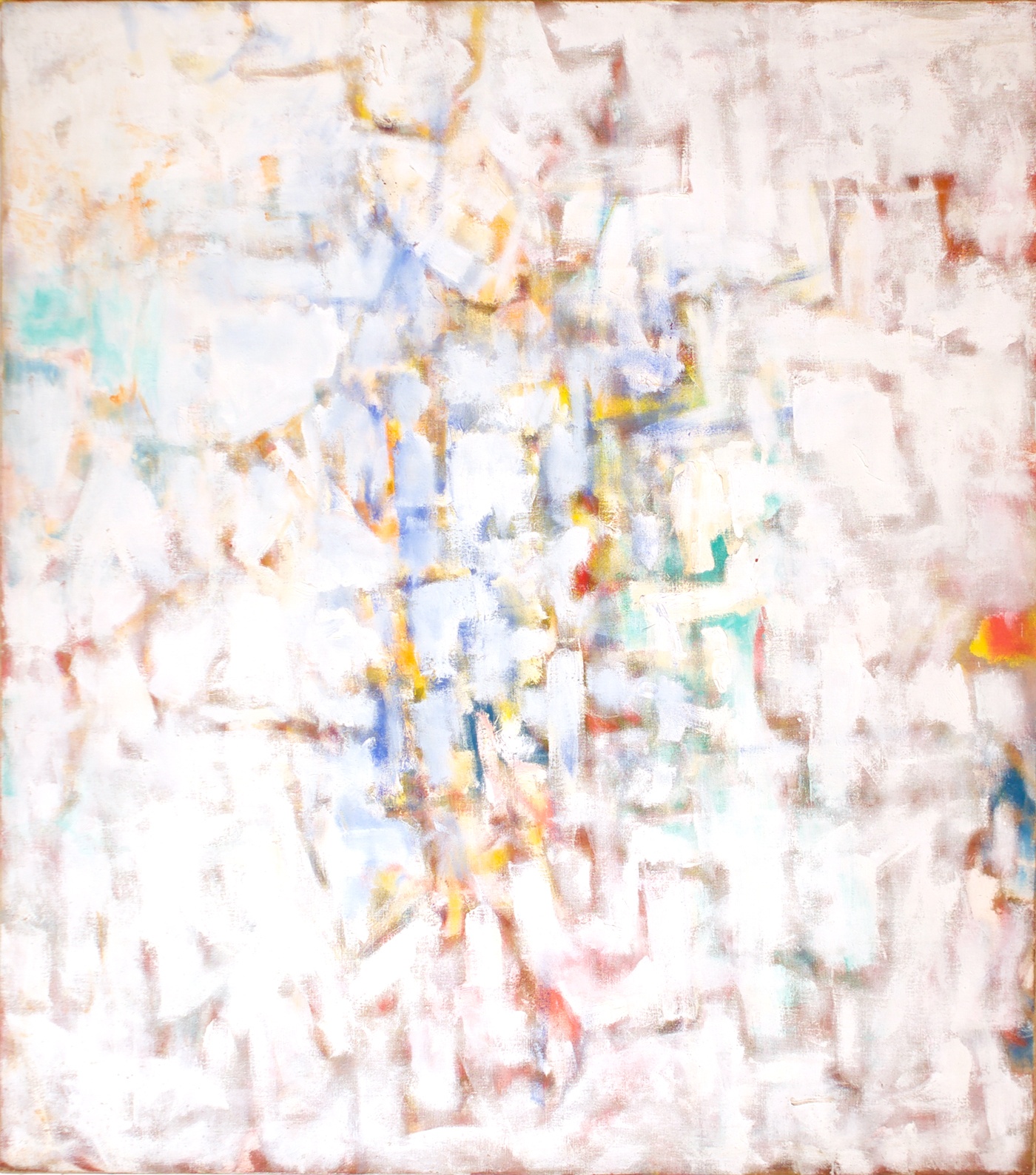
SEYMOUR BOARDMAN (1921-2005), April 3, 1960, Oil on Canvas, 48” x 54” (more)
Seymour Boardman
American
(1921-2005 )
Biography
Seymour Boardman (19212005) was a New York abstract expressionist. Since his first solo exhibition in Paris in 1951, Boardman developed a personal
vision and style of his own, following his own path of abstraction. As a painter, he sought to reduce the image to its bare essence.
Seymour Boardman majored in art at City College of New York in 1938-1942. He served in the United States Air Force from 1942–1946, during which he was hospitalized for over a year due to a wound to his left shoulder, which resulted in partial paralysis of the arm and hand.
After a full medical discharge from the service in 1946, he left for Paris to continue his art education at the École des Beaux-Arts, Académie de la Grande Chaumière, and Atelier Fernand Léger. Boardman’s work became more abstract but still based on figure and landscape. He returned to New York in 1949 and went to the Art Students League. Boardman continued to paint dark, moody paintings using a limited palette of black, white, grey, and an occasional additional color. Departed Le Havre France on the Liberte, arriving with his wife in New York on Jan. 22, 1952. In 1955, he had his first one-man show in New York at the Martha Jackson Gallery. It was favorably reviewed by Hilton Kramer, Emily Genauer, Fairfield Porter, and others. “…inscrutable, dark, mostly in blacks stained here and there with calm whitish shapes, they yet manage to suggest something inhuman and romantic…” (N.Y.Times, March 26, 1955). He began to acquire recognition in the 1950s with his paintings of griddled facets seen as if through a frosted glass, without any crisp lines, and in bright colors favoring reds. Boardman’s friends included Lawrence Calcagno, Perez Celis, John Hultberg, Burt Hasen, Frank Lobdell, Richards Ruben, Robert Ryman and Nassos Daphnis.
Throughout the 1960s, Boardman showed at both the Stephen Radich Gallery and the A.M. Sachs Gallery; in 1967, The Whitney Museum of American Art and the Guggenheim Museum acquired a painting each. In the early 1970s Boardman had a large exhibition of paintings at the Andrew Dickson White Museum of Art, (currently Herbert F. Johnson Museum of Art), Cornell University, Albany, NY. Thomas Levitt, the Director, wrote in the catalogue, “…Seymour Boardman has gradually eliminated the arbitrary aspects of his work until only straight lines and two or three areas of flat, usually somber, tones remain…” This accurately describes the paintings of that period. He continued to work that way during the 1970s.
Seymour Boardman was an artist who expressed his direct experience and willingness to take risks in the pursuit of ambitious painting. Initially working in the freely brushed manner of Abstract Expressionism, Boardman gradually eliminated the arbitrary aspects of his work until only straight lines and two or three areas of flat, sometimes somber, tones remained. He could hardly have achieved more with less.
In a career that was steady and determined, Seymour Boardman created paintings that are unique, while avoiding fashion and trends. His work stands alone because it derives from the Romantic landscape previously articulated by Avery and early Rothko (who was a friend) and later developed into almost hard-edged painting. Seymour Boardman’s paintings are objects for contemplation.
Selected Public Collections
The Guggenheim Museum of Art, NY
Whitney Museum of Art, New York City
National Museum of American Art, Washington, D.C
Santa Barbara Museum of Art, CA
San Francisco Museum of Art, CA
Herbert F. Johnson Museum, NY
Rose Art Museum, Brandeis University, NY
Andrew Dickson White Museum of Art, NY
Smithsonian Institution, Washington, D.C
New York University, New York City
The State University of New York, Postdam, NY
Wagner College, Staten Island, NY
Wright State College Art Gallery, Dayton, OH
Walker Art Center, MN
Josiah White Exhibition Center, PA
Anderson Gallery, NY
Gallerie Beyeler, Switzerland